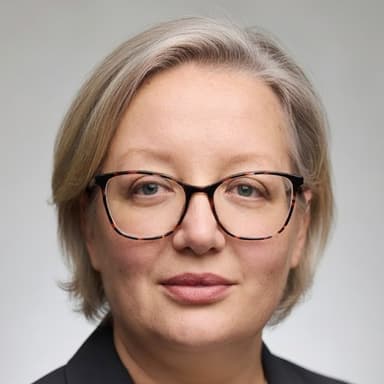
Betreuungskraft · Founder, Mementio.Care
Jasminka Trkulja
Dementia care specialist, Betreuungskraft under §43b SGB XI, and founder of Mementio.Care.
Seventeen years on the same corridor
I have worked in the protected dementia unit at Martin Luther Haus in Münster for seventeen years — the part of a care home most visitors never see, where people live whose memories have loosened their grip on the world.
I know which resident settles when a certain song is played, which one needs the door left open, which one is calmest in the late afternoon and which one is not. None of that is in a file. You learn it slowly, by staying.
That knowledge is the foundation of everything I offer through Mementio.Care.
A different route into care
I did not train for this work as a young woman. I came to Germany after my marriage without speaking a word of German, and learned the language from the beginning — a path that eventually led me to the FH Münster.
While I was still finding my own footing, I began volunteering as a translator for immigrants from the former Yugoslavia. I sat beside people in offices and appointments where being understood mattered enormously, and was not at all guaranteed. It was through that work, and a referral from social services, that I came into care.
I have never forgotten what it felt like to be capable and still unheard. It shapes how I work with families now, and it is one of the reasons I work in six languages. For a daughter trying to understand her mother's diagnosis, or a family navigating the German care system in a second or third language, being met in your own words is not a small thing.
What the work actually looks like
I am a qualified Betreuungskraft under § 43b SGB XI and work within the social services team of the protected unit. My work has three strands.
With residents
Daily accompaniment of people living with dementia — the structure, familiarity and dignity that make a day feel navigable rather than frightening. I try to meet a person where they are, not where the diagnosis says they should be. And I stay to the end: I accompany residents through palliative care, in the last weeks and days, so that nobody in my care has to go through that part alone. Being present then is not a separate task to me. It is the same work, at its most important.
With families
I counsel relatives through the parts nobody prepares you for: the guilt of choosing a care home, the grief of being forgotten by someone who is still alive, the practical questions and the ones that have no clean answer. I listen first. I don't push anyone toward acceptance before they are ready.
With the next generation
I mentor nursing students on placement, informally and by choice. I try to pass on what isn't in the curriculum — how to enter a room, how to sit with agitation without escalating it, how to protect your own reserves so that you are still doing this work in ten years.
Where this is going
I am now formalising what practice has taught me. I am pursuing a degree in social work, with the long-term aim of specialising in gerontology, and building Mementio.Care as a place where that combination — lived expertise and academic grounding — can reach more people than one corridor can hold.
My direction is teaching, consulting and mentoring: for families who need guidance, for care teams who need practical training, and increasingly across borders, in German, English and the languages of the Balkans.
The idea behind Mementio.Care
Dementia is usually described in the language of loss. I work from the other direction — from what remains, and from what can still be reached.
Care. Dignity. Trust. Not a slogan. A description of the minimum a person is owed.